
Klaviyo Predictive Analytics: How to Use CLV, Churn Risk, and Expected Next Order Date to Drive Retention

Klaviyo's predictive analytics gives you three fields — predicted CLV, churn risk, and expected date of next order — that can fundamentally change how you segment, trigger flows, and time campaigns. Most brands never build anything with them. This guide gives you the exact segment definitions, flow configurations, and validation steps to turn predictions into retention revenue.
Predictive analytics is the most underused feature in most Klaviyo accounts. Not because brands don't know it exists — the data sits right on customer profiles — but because nobody has shown them how to wire those predictions into segments and flows that actually generate revenue.
The result: three powerful predictive properties collecting dust as dashboard decorations. No segments built off them. No flows triggered by them. No validation confirming the predictions are even accurate for your store.
This article changes that. For each predictive field, you get the segment builder configuration, the flow architecture, and the measurement approach — plus the data requirements to meet before any of it is worth building. If you're new to building flows in Klaviyo, start with our complete flow setup guide first, then come back here for the predictive layer.
Last updated: August 2026
What Does Klaviyo Predictive Analytics Actually Create?
Klaviyo's predictive analytics uses machine learning models trained on your store's historical purchase data to generate three forward-looking properties on every customer profile: predicted customer lifetime value, churn risk level, and expected date of next order. These update automatically as new data flows in, creating dynamic fields you can build segments and trigger flows from.
Klaviyo is an email and SMS marketing platform built for ecommerce brands that integrates with Shopify and other platforms to power lifecycle marketing automation.
Klaviyo Segments are dynamic groups of customer profiles that automatically update based on shared properties, behaviors, or predictive attributes. Klaviyo Flows are automated email or SMS sequences that trigger based on specific customer actions or profile conditions.
Customer lifetime value is the total revenue a customer generates across their entire relationship with a brand. Predicted Customer Lifetime Value (CLV) is Klaviyo's estimate of the total revenue a customer will generate over their entire relationship with your brand, based on their purchase patterns and the behavior of similar customers in your account. Unlike historic CLV — which sums up what a customer has already spent — predicted CLV looks forward. It tells you what a customer is likely to be worth.
This is where predictive CLV extends traditional RFM analysis. RFM segmentation is a method of categorizing customers based on how recently they purchased (recency), how frequently they buy (frequency), and how much they spend (monetary value). RFM scores what customers have done. Predicted CLV scores what they're likely to do next. They complement each other: RFM is your rearview mirror, predicted CLV is your windshield.
Churn risk prediction is Klaviyo's assessment of how likely a customer is to stop purchasing from your store. Klaviyo categorizes profiles into risk levels — from low risk (likely to keep buying) to high risk (likely gone unless you intervene). The prediction updates as customer behavior changes, making it a living signal rather than a static tag.
Expected date of next order is Klaviyo's prediction of when each customer will place their next purchase, calculated from their historical purchase frequency and the patterns of similar buyers in your account. This is the precision-timing field — it lets you send replenishment reminders based on each customer's individual purchase rhythm instead of static calendar-based timing.
How the three predictive fields compare
- Predicted CLV: Answers "how much is this customer worth?" — drives tiered segmentation, differentiated treatment, and resource allocation across your lifecycle program.
- Churn Risk: Answers "is this customer about to leave?" — drives preemptive winback flows and intervention timing before it's too late.
- Expected Date of Next Order: Answers "when will this customer buy again?" — drives precision-timed replenishment flows and campaign sends matched to individual purchase rhythms.
Each field requires a different implementation approach. The rest of this article treats each one as its own playbook.
How Much Data Does Klaviyo Need for Predictive Analytics to Work?
Klaviyo's predictive models need a meaningful volume of order history and customer profiles before predictions become reliable enough to automate against. If your store is new, has a small customer base, or recently migrated to Klaviyo, the predictions may be thin, missing, or unreliable — and building flows on unreliable predictions means optimizing against noise instead of signal.
Klaviyo's predictive analytics documentation outlines the data requirements for each property. The core requirement is sufficient order history — both in volume of customers and in repeat purchase patterns — for the machine learning models to identify meaningful behavioral signals.
In practice, this means a few things for your implementation timeline:
- Not every profile gets predictions. Profiles with only one order, or profiles imported without purchase history, may not have predictive properties at all. Check your account — if the majority of profiles are missing these fields, your data volume likely isn't there yet.
- Predictions improve with more data. The models retrain as new orders come in. A store that's been on Klaviyo for several months with consistent order flow will have meaningfully better predictions than one that migrated recently.
- Your Shopify integration must be clean. Predictive models are only as good as the data feeding them. If your Shopify-Klaviyo sync is missing order events, has duplicate profiles, or isn't tracking product data correctly, the predictions suffer.
What to do when you're below threshold
If your store doesn't have enough data for reliable predictions yet, don't wait — use behavioral proxies instead. Build segments based on actual purchase recency, frequency, and average order value using the RFM approach. Trigger winback flows based on days since last purchase, not predicted churn risk. Time replenishment reminders based on your product's average consumption cycle, not the predicted next order date.
These behavioral approaches aren't as precise as predictions, but they work immediately and give the models time to accumulate the data they need. Layer in predictive segments once you confirm the properties are populating reliably across most of your customer profiles.
How Do You Use Predicted CLV to Build Segments and Flows?
Predicted CLV is your resource allocation engine — it tells you which customers deserve VIP treatment, which ones need nurturing to reach their potential, and which ones aren't worth the same level of investment. Build three to four CLV tiers in Klaviyo's segment builder, then differentiate your welcome flow, campaign targeting, and offer strategy based on predicted value.
The implementation starts in your segment builder. Create dynamic segments (not static lists) so profiles move between tiers automatically as their predicted CLV updates.
Building your CLV tiers
- Navigate to your Klaviyo analytics dashboard and pull the distribution of predicted CLV values across your customer base. Identify the natural breakpoints — the median, the 75th percentile, and the 90th percentile.
- Create three or four segments using the "Predicted Customer Lifetime Value" property with "is greater than" and "is less than" operators:
- High CLV: Top tier — your predicted VIPs. These customers are projected to be worth the most over time.
- Medium CLV: Middle tier — solid customers with growth potential.
- Low CLV: Bottom tier — one-time or low-frequency buyers who may never become high-value.
- Verify each segment has enough profiles to be actionable. If your High CLV segment has fewer than a few hundred profiles, your tiers may be too narrow for meaningful automation.
This layered approach fits into a broader segmentation architecture — predictive segments are an additional layer on top of engagement and behavioral segments, not a replacement for them.
What to build with CLV tiers
Welcome flow differentiation: When a new subscriber's predicted CLV populates (which may require their first purchase plus model processing time), branch your welcome flow. High-CLV profiles get VIP treatment — early access, personal touches, founder-style messaging. Low-CLV profiles get education-focused content designed to increase their purchase frequency before they lapse.
Campaign send strategy: Your highest-CLV customers should never receive generic discount blasts. They buy because they love the brand, not because of a coupon. Protect their full-price buying behavior with exclusive access, early product drops, and recognition — not percentage-off campaigns.
Offer architecture: Reserve your deepest discounts for Medium-CLV customers where a nudge could meaningfully shift their trajectory. For Low-CLV customers, A/B test whether non-discount incentives — free shipping, gift with purchase — perform equally before committing to heavy discounting that eats margin.
Welcome flows typically generate between $3 and $8 in revenue per recipient according to Blossom's benchmark data. CLV-tiered welcome flows with differentiated treatment paths tend to push the upper end of that range by matching message intensity to customer value — you invest more persuasion in the profiles worth more.
How Do You Use Churn Risk to Trigger Preemptive Winback Flows?
Churn risk is your early warning system. Instead of waiting a fixed number of days after someone's last purchase to trigger a winback, you can intervene the moment Klaviyo's model identifies a customer as likely to churn — often weeks before a static time-based trigger would fire. The result is a preemptive winback flow that reaches at-risk customers while you can still influence their behavior.
This is where predictive analytics earns its keep. A standard time-based winback flow fires at a fixed interval — say, 90 days after last purchase. But purchase cycles vary wildly across customers. A monthly buyer is at risk at 45 days. A quarterly buyer is fine at 90 days. Static timing treats both the same, which means you're either too early for one or too late for the other.
Churn risk prediction solves this by evaluating each customer's individual pattern against similar buyers in your account.
Building churn risk segments
In Klaviyo's segment builder, use the "Predicted Churn Risk" property to create intervention tiers:
- High churn risk: These customers are predicted to stop buying. They need intervention now — before they mentally check out and stop opening emails entirely.
- Medium churn risk: Warning zone. These customers are drifting but haven't disengaged yet. A well-timed touchpoint can pull them back.
- Low churn risk: Healthy customers. No intervention needed — let your regular post-purchase and campaign cadence do the work.
The predictive winback flow
Build a flow triggered by segment entry into your high churn risk segment. When a customer's risk level shifts from medium to high, the flow fires automatically. The messaging arc follows the same structure as a standard winback — re-engagement, value reminder, incentive escalation — but with better timing.
Structure the sequence with three to four emails over two to three weeks. Lead with value in the first touch: what's new, what they're missing, a product recommendation based on their purchase history. Escalate to an incentive only in the second or third email if the first doesn't convert.
Standard winback flows convert in the range of two to five percent and generate roughly $2–6 per recipient according to Blossom's benchmark data. Churn-risk-triggered winbacks tend to outperform those ranges because the timing is matched to individual customer behavior rather than arbitrary calendar rules.
The critical implementation detail: your predictive winback flow runs alongside your time-based winback, not instead of it. Use Klaviyo's flow filters to prevent a customer from being in both simultaneously — the predictive flow should take priority when both would trigger, since its timing is more personalized.
How Do You Use Expected Date of Next Order for Precision Timing?
Expected date of next order is your precision timing tool — it replaces static replenishment schedules with individualized send timing based on each customer's actual purchase rhythm. Instead of emailing every customer on a fixed schedule because your product is a consumable, you send each customer a reminder timed to when Klaviyo predicts they'll actually need to reorder.
Replenishment flow is an automated sequence triggered by a predicted reorder window — the goal is to remind customers to restock before they run out, not after they've already switched to a competitor or forgotten about your brand.
Build a flow triggered by the segment "Expected Date of Next Order is within the next 7 days." This gives you a week-long window to reach the customer before Klaviyo predicts they'll buy. The first email is purely functional — a friendly heads-up that they're likely running low, with a direct reorder link. If no purchase within three to five days, follow up with a benefits reminder or a subscription offer.
Replenishment flows typically convert in the range of five to ten percent, with revenue per recipient between $4 and $10 according to Blossom's benchmark data. These numbers are strong because the customer is already satisfied — they've used the product and liked it. You're making the reorder frictionless, not persuading from scratch.
Campaign timing with expected next order date
Beyond flows, expected next order date sharpens your campaign targeting. Build a segment of customers predicted to order within the next two weeks and prioritize them for product-focused campaigns. These customers are in the buying window — they're more likely to click, more likely to convert, and more likely to respond to a product recommendation than someone who purchased recently and won't need anything for months.
You can also invert this: exclude customers whose expected next order date is far out from your heavy promotional sends. They're not in buying mode yet, and emailing them aggressively while they don't need your product trains them to ignore you when they do.
How Do You Validate Predictions Before Building Automations?
Before you build automations around Klaviyo's predictive fields, validate that the predictions are actually accurate for your store. A prediction is a model's best guess — and models can be wrong, especially with limited data, unusual purchase patterns, or product categories the algorithm hasn't seen enough of. Validating first prevents you from optimizing against noise.
Here's a straightforward validation approach you can run before committing to predictive automation:
- Compare predicted CLV against actual CLV for a past cohort. Pick a cohort of customers from six to twelve months ago. Pull their predicted CLV values from that period and compare to their actual realized revenue since. If predictions clustered within a reasonable range of actual outcomes, the model is working. If there's no correlation, the model needs more data — or your purchase patterns may be too irregular for reliable prediction.
- Test churn risk against actual behavior. Pull a group of customers who were flagged as "high churn risk" 90 days ago. How many actually churned — zero purchases since? How many bought again? If the high-risk group churned at a meaningfully higher rate than the low-risk group, the signal is real and worth automating against.
- Check expected next order date accuracy. For customers who did reorder, compare the predicted date to the actual date. You're looking for the prediction to be directionally right — within a week or two of the actual order — not perfectly precise. Directional accuracy is enough for replenishment timing.
- Run a holdout test on your first predictive flow. When you launch a churn-risk winback or predicted-reorder flow, suppress a small percentage of qualifying profiles as a holdout group. Compare conversion rates between the group that received the flow and the group that didn't. This tells you whether the predictive flow is actually incremental — or just reaching people who would have purchased anyway. For methodology on holdout and incrementality testing, see our guide on email revenue attribution.
Validation isn't a one-time exercise. As your customer base grows and purchase patterns evolve, re-run these checks quarterly. Predictions that were accurate six months ago may drift as your product mix, pricing, or customer demographics change. The models improve with more data — the earlier you start feeding them clean event data through your Klaviyo predictive analytics setup, the faster they become reliable.
Start With the Field That Matches Your Biggest Gap
You don't need to implement all three predictive playbooks at once — start with the single field that addresses your biggest retention gap. Each predictive property solves a different problem, and the models compound in accuracy as they accumulate more data, so beginning with one and layering the others over time is the most effective approach.
Match the field to your biggest retention gap:
- If your welcome flow treats every subscriber the same regardless of potential value → start with predicted CLV tiers.
- If your winback flow fires on a static timer and misses customers who churn between cycles → start with churn risk.
- If you sell consumable products and your replenishment timing is guesswork → start with expected date of next order.
Each predictive field compounds over time. The models get better as they accumulate more data. The segments get sharper as more profiles receive predictions. And the revenue impact grows as you layer predictive flows on top of your existing lifecycle architecture — they don't replace your core flows, they make the timing and targeting smarter.
The brands that activate predictive analytics now build a data advantage that widens every month. The ones that wait are still guessing.
FAQ
These frequently asked questions cover the practical details of implementing Klaviyo's predictive analytics — from data requirements and model accuracy to the differences between predicted and historic CLV, how to trigger flows from predictive properties, and how to validate predictions before building automations around them.
How does Klaviyo predictive analytics work?
Klaviyo uses machine learning models trained on your store's historical order data to generate forward-looking predictions for each customer profile. The models analyze purchase frequency, order value, timing patterns, and the behavior of similar customers to predict CLV, churn risk, and expected next order date. These properties update automatically as new data flows in and can be used in segments and flow triggers.
How many orders does Klaviyo need for predictive analytics to work?
Klaviyo requires a meaningful volume of order history across your customer base before predictions become reliable. Stores with limited purchase data, few repeat buyers, or recent Klaviyo migrations may see incomplete or missing predictions on customer profiles. The models improve continuously as more orders accumulate — if predictions aren't populating across most profiles, your account likely needs more time and data before building automations around them.
What is the difference between predicted CLV and historic CLV in Klaviyo?
Historic CLV sums up the total revenue a customer has already generated — it's a backward-looking metric. Predicted CLV estimates the total revenue a customer is likely to generate in the future, based on their purchase patterns and the behavior of similar customers. Historic CLV tells you what happened. Predicted CLV tells you what's likely to happen next, which makes it more useful for forward-looking segmentation and resource allocation decisions.
Can you trigger Klaviyo flows based on predictive analytics?
Yes. You trigger flows based on segment entry, and you can build segments using any predictive property. A flow triggered by entry into a "high churn risk" segment fires automatically when a customer's risk level changes. Similarly, a flow triggered by "expected date of next order is within the next 7 days" sends replenishment reminders timed to each customer's individual purchase rhythm rather than a static calendar schedule.
How accurate is Klaviyo's expected date of next order?
Accuracy depends on your store's data quality and the consistency of your customers' purchase patterns. For stores with strong repeat purchase behavior and clean Shopify-Klaviyo data sync, predictions are typically directionally accurate — within a reasonable window of actual reorder dates. For stores with irregular purchase patterns or limited order history, accuracy will be lower. Validate by comparing predicted dates against actual reorder dates for a past cohort before building automations.
Get tactics like this in your inbox every week. Subscribe to our newsletter →
Need help implementing this?
Let us take the hassle of managing your email marketing channel off your hands. Book a strategy call with our team today and see how we can scale your revenue, customer retention, and lifetime value with tailored strategies. Click here to get started.
Curious about how your Klaviyo is performing?
We’ll audit your account for free. Discover hidden opportunities to boost your revenue, and find out what you’re doing right and what could be done better. Click here to claim your free Klaviyo audit.
Want to see how we’ve helped brands just like yours scale?
Check out our case studies and see the impact for yourself. Click here to explore.

Read Our Other Blogs

Sunset Flow: How to Win Back Unengaged Subscribers Before You Suppress Them



Welcome Flow Optimization: How to Turn New Subscribers Into First-Time Buyers Faster

Popup Strategy for Ecommerce: How to Grow Your List Without Training Customers to Wait for Discounts

Free Gift With Purchase vs Discount: Which Offer Protects Margin and Still Converts

VIP Early Access Campaigns: How to Reward Best Customers Without Giving Anything Away

Gmail and Yahoo Bulk Sender Requirements: The Compliance Checklist Ecommerce Brands Can't Ignore

Spam Complaint Rate: Why 0.3% Is the Cliff Edge and How to Stay Far Below It

Klaviyo Custom Events: How to Track the Ecommerce Behaviors Shopify Doesn't Send by Default

Klaviyo vs Postscript: Choosing Your SMS Platform When You're Already on Klaviyo Email

Repeat Purchase Rate: The Diagnostic Framework for Finding Where Your Second Order Is Breaking Down
Apple Mail Privacy Protection: How to Measure Email Engagement When Opens Are Broken

Back-in-Stock Flow: The Highest-Intent Email Sequence Most Brands Never Build

Email Holdout Testing: How to Prove Your Retention Channel Is Actually Incremental

Klaviyo vs Omnisend: Which ESP Is Right for Your DTC Brand in 2026

Dedicated IP vs Shared IP for Ecommerce Email: When to Switch and When It Backfires

Quiz Funnels for Ecommerce: How to Grow Your List and Segment Subscribers Without Discounts

Klaviyo + Shopify Integration: The Complete Data Sync and Event Tracking Setup Guide

How to Repair Sender Reputation: The Recovery Playbook When Your Emails Land in Spam

Abandoned Cart Flow Strategy: Why Your Recovery Sequence Stops Working After Email One

Ecommerce Email Benchmarks: What Good Actually Looks Like for DTC Brands in 2026
Retention-Focused A/B Testing: What to Test in Email When You've Already Optimized the Basics

Klaviyo Segments vs Lists: How to Structure Your Audience Architecture for Scalable Retention

Email Deliverability for Ecommerce: The Complete Guide to Landing in the Inbox

Klaviyo List Hygiene: How to Clean Your Email List Without Killing Your Revenue
Sunset Flow: How to Win Back Unengaged Subscribers Before You Suppress Them
Welcome Flow Optimization: How to Turn New Subscribers Into First-Time Buyers Faster
Popup Strategy for Ecommerce: How to Grow Your List Without Training Customers to Wait for Discounts

Email Offer Architecture: How to Structure Promotions That Protect Margin and Still Convert

Klaviyo vs Attentive: Which Platform Is Right for Your DTC Stack in 2026

Migrating to Klaviyo: The Step-by-Step Playbook for Switching ESPs Without Losing Revenue

Browse Abandonment Flow: The Underbuilt Sequence Quietly Leaking Revenue

Post-Purchase SMS Flow: How to Use Text Messages to Build Loyalty After the First Order

Retention Marketing Dashboard: The Exact Metrics and Reports You Should Be Reviewing Weekly

Agency vs In-House Email Marketing: What Actually Moves the Needle for DTC Brands

SMS Marketing Strategy for Ecommerce: The Complete Guide

How to Set Up Klaviyo Flows: Complete Setup Guide

A/B Testing for Email: What to Test, How to Measure, When to Ship

Email Marketing KPIs: The Only Metrics That Matter for DTC

Email Revenue Attribution: What Klaviyo Gets Right and Wrong

Popup Strategy for Ecommerce: 6 Types That Actually Convert

RFM Analysis for Ecommerce: Segment Your Customers by Value

Email Segmentation for Ecommerce: The 5-Layer Model for DTC Brands

Welcome Offer Optimization: Converting Subscribers Without Deep Discounts

Email Warmup Strategy: How to Build Sender Reputation From Scratch

Email List Hygiene: How to Clean Your List Without Killing Revenue

SPF, DKIM, and DMARC: Email Authentication Explained for DTC Brands

The Complete Retention Marketing Strategy Guide (2026)

Winback Flow: How to Re-Engage Lapsed Customers Before You Lose Them

How to Audit Your Email Flows (The 125-Point Checklist)

Post-Purchase Email Flow: The Architecture That Drives Repeat Buyers

Sunset Flow: When and How to Remove Unengaged Subscribers

Cart Abandonment Flow: How to Recover Revenue Without Discounting

How to Build a Welcome Flow That Actually Converts

How to Build an Email Campaign Calendar Without Discounting

Browse Abandonment Flow: Converting Window Shoppers Into Buyers

The Abandoned Cart Email Strategy That Actually Recovers Revenue

How to Build a Welcome Flow That Actually Converts

Personalizing Push Notifications for Better Retention Outcomes

How to Craft Email Newsletters That Build Real Brand Loyalty
Top 3 Best eCommerce Content Management Systems of 2025
Email Marketing vs. Social Media: Which One Should Your Brand Focus On?

Attract More Customers: Which Videos to Use in Your Email Marketing and Why
8 eCommerce Customer Service Mistakes You NEED to Stop Making (Like, Yesterday)
Creating The Perfect E-Commerce Tech Stack

Types of Content eCommerce Brands Need in Their Marketing Mix
Ecommerce Email Mistakes: Blossom Ecom Article on How to Stop Sending Bad Emails & Start Making More Money
Boost Your Bottom Line: The Ultimate Guide to Integrating Website and Email Strategies for Your eCommerce Business
6 Powerful Ecommerce Loyalty Program Examples (and How to Build Your Own)
Loyalty-First Guide to Customer Reactivation Email Campaigns
Using Email Marketing to Supercharge Your Loyalty Program
Unpacking Brand and Conversion in E-Commerce Design
13 Scary E-Commerce Mistakes (and How to Avoid Them)
How to Reduce Your E-Commerce Bounce Rate and Boost Engagement
Combining Content and Commerce for E-Commerce Success
Email Marketing Tips + Trends

E-Commerce Returns Analysis & Crafting a Profitable Returns Policy

9 Pro Tips for A/B Testing Emails with HubSpot
AI and Email Marketing: The Future is Here
How to Skyrocket Your Email Open Rates and Click-Through Rates
Email Isn’t Dead: 4 Reasons It’s Still a Digital Marketing Powerhouse

Email Marketing Series – #3: Building a Strong Email List
Email Marketing Series – #4: 9 Tips for Creating High-Impact Email CTAs

Email Marketing Series – #2: How to Craft Attention-Grabbing Subject Lines
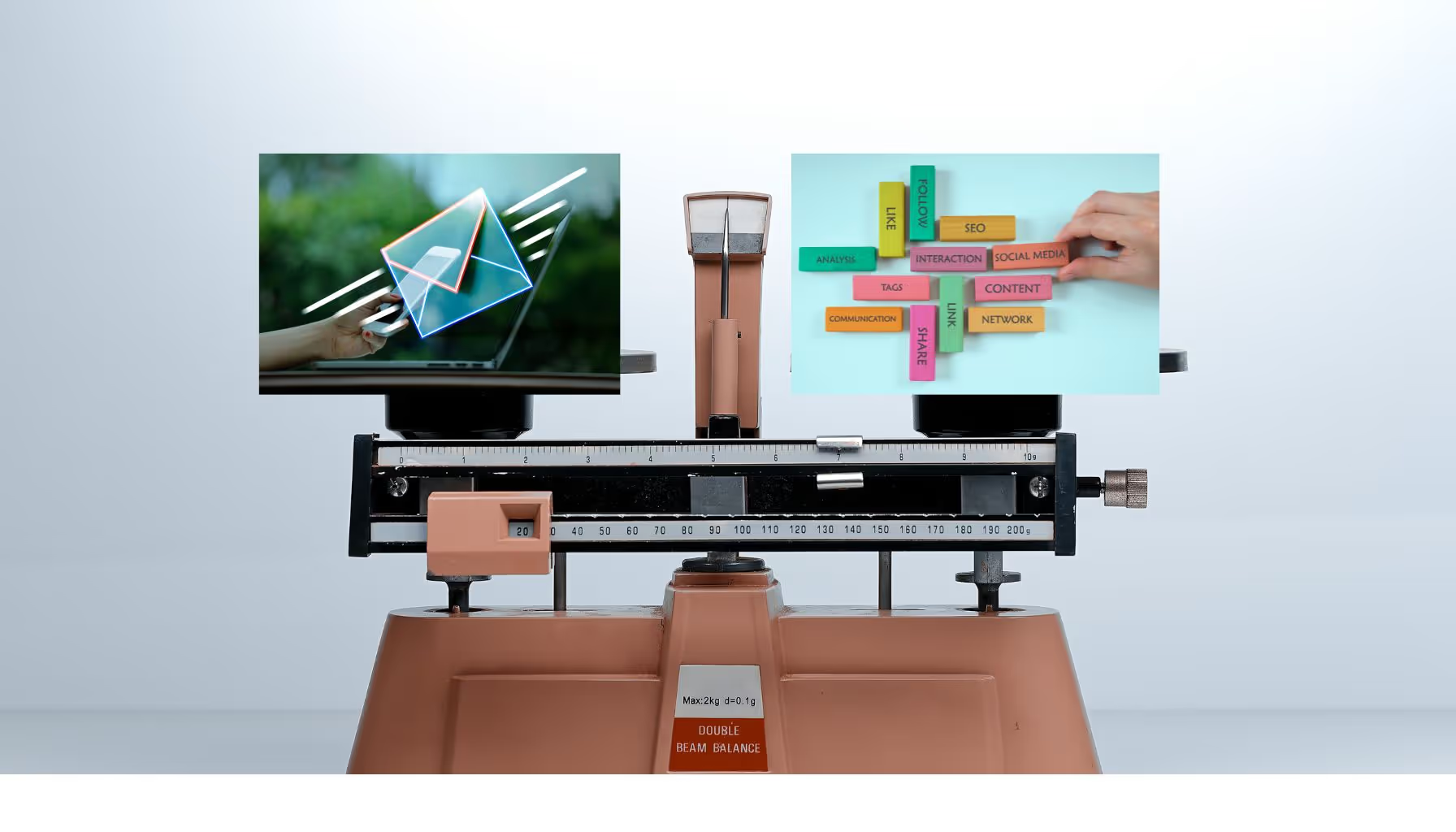
Email Marketing vs. Social Media Marketing — Which Should I Use?
Email Marketing Series – #1: Crafting an Effective Email Marketing Strategy
Email Open Rate: A Practical Guide
3 Effective Strategies to Make Email Your Marketing Heavyweight Champion

How to Attract New Leads with Video in Your Email Marketing
How to Determine the Profitability of Your eCommerce Website
Multi-Channel eCommerce: The Key to Growing Your Online Business
Understanding eCommerce Conversion Rate & Optimization
How to Optimize Your eCommerce Website for More Conversions
Top 3 eCommerce and Digital Marketing Trends for 2025

Optimizing Your Email Marketing Strategy: A/B Testing Explained
35 Eye-Opening Email Marketing Stats You Need to Know
7 Email Marketing Tips to Boost Your SEO

11 Common Email Marketing Mistakes That Are Tanking Your Conversions (And How to Fix Them)
Strategic SEO Tips for Email Marketing: Boost Engagement and ROI
How to Measure and Increase Email Marketing ROI (Plus Templates That Convert!)

Do Lifecycle Email Campaigns Really Drive Conversions? Here’s What We Found
How to Use Remailing in Your Email Marketing Strategy

B2B Email Marketing: Building Relationships and Converting Leads
Core Email Marketing Flows: 2025 Essentials for Shopify


Not Sure Where to Start?
Let's find the biggest retention opportunities in your business. Get a free Klaviyo audit or retention consultation.