
TL;DR: Build a 2–3 email cart abandonment sequence timed at 1 hour, 24 hours, and 48–72 hours. Skip the automatic discount—use friction removal first. Add SMS after email, not instead of it. The right sequence length depends on your AOV and brand positioning: low-AOV impulse products need 2 emails; mid-AOV considered purchases need 3; premium brands need 3–4 with no discount, ever.
A well-built cart abandonment flow recovers 5–12% of abandoned carts and generates more revenue per recipient than almost any other automated flow in your program. A poorly built one trains your customers to abandon on purpose.
Here's the thing nobody says out loud: the standard 3-email-plus-discount sequence isn't a strategy. It's what Klaviyo sets up by default, what every agency template uses, and what your competitors are running right now. When everyone is running the same playbook, no one is winning.
According to the Baymard Institute (2024), roughly 70% of online shopping carts are abandoned before checkout. That's the stakes. This article gives you the decision framework to build a cart recovery sequence that fits your brand—sequence length, timing, offer logic, and channel coordination—and explains exactly why the default approach costs you more than it recovers.
What Is a Good Abandoned Cart Email Recovery Rate?
A healthy cart abandonment flow converts 5–12% of abandoned carts into completed orders, with revenue per recipient (RPR) typically falling between $5 and $15 depending on your average order value and offer strategy. If your flow is recovering carts below the numbers that depend on your setup threshold, the sequence, timing, or offer logic needs work—not your subject lines.
Cart recovery rate is the percentage of abandoned carts that result in a completed purchase after receiving at least one email in your flow. It's the primary KPI for this flow, but it tells an incomplete story on its own.
The metric that matters more is revenue per recipient (RPR)—the average revenue generated per email delivered in the flow, calculated by dividing total flow revenue by total emails sent. RPR tells you whether your sequence is efficient or just busy. A solid recovery rate with a low RPR means you're recovering carts at fire-sale prices. A competitive recovery rate with a strong RPR means your offer strategy is working.
Track both. Optimize for RPR.
How Many Abandoned Cart Emails Should You Send?
Most brands should send 3 emails over 48–72 hours. But the right number for your brand depends on three variables: your average order value, your product category (impulse versus considered purchase), and your brand's positioning on price. A low-AOV supplement doesn't need the same sequence as a high-AOV skincare kit.
Here's the decision framework we call the Cart Recovery Decision Tree:
For Low AOV (< performance that shifts with your audience) / Impulse-Buy Products
- Sequence length: 2 emails maximum
- Timing: Email 1 at 1 hour, Email 2 at 24 hours
- Offer logic: No discount in Email 1. Free shipping or a small incentive in Email 2 only if your margins allow.
- Why: Low-AOV impulse purchases are often price-driven to begin with. Adding a discount signals that the regular price wasn't real. A clean reminder with frictionless checkout (easy return, fast shipping) recovers most of what's recoverable.
For Mid AOV (figures that differ across accounts) / Considered Purchases
- Sequence length: 3 emails
- Timing: Email 1 at 1 hour, Email 2 at 24 hours, Email 3 at 48–72 hours
- Offer logic: No offer in Emails 1–2. Conditional offer in Email 3 (free shipping first, discount as a fallback).
- Why: These customers are comparing options or sitting on a decision. Emails 1 and 2 do the work of handling objections and building confidence. Email 3 closes with a reason to act now.
For High AOV (> outcomes tied to your specific list) / Premium Brands
- Sequence length: 3 emails, possibly 4 for high-complexity products
- Timing: Email 1 at 1 hour, Email 2 at 24–36 hours, Email 3 at 72 hours
- Offer logic: No discount. Ever, ideally. Use objection removal instead: easy returns, financing options, customer support, reviews.
- Why: Discounting a results that vary by program+ item on Email 3 trains premium-brand buyers that your prices are negotiable. It also compresses the perceived value of everything you sell. The conversion mechanism here is confidence, not price.
What Is the Best Time to Send an Abandoned Cart Email?
Send Email 1 within 60 minutes of abandonment. This single timing variable has more impact on recovery rate than subject lines, design, or offer strategy combined. After 60 minutes, recovery rates drop measurably—the purchase window closes as attention moves elsewhere.
But here's what most guides miss: the gap between Email 1 and Email 2 matters just as much as Email 1's timing, and almost no one optimizes it.
In our experience with DTC brands, a 23–26 hour gap between Email 1 and Email 2 consistently outperforms a 12-hour gap. Why? A 12-hour gap feels aggressive and often catches the subscriber at an inconvenient time. A 24-hour gap gives the contact a full day to reconsider organically, then reaches them at roughly the same time of day they originally browsed—a behavioral timing that often coincides with their natural shopping window.
For Email 3, 48–72 hours after abandonment is the right zone for most brands. Beyond 72 hours, the intent signal has largely decayed. The exceptions: high-consideration, high-AOV products where the research and decision cycle is genuinely longer (furniture, fitness equipment, professional tools).
The highest-leverage optimization in a cart abandonment flow isn't the subject line on Email 3. It's getting Email 1 out in under 60 minutes and spacing Emails 2 and 3 at 24-hour intervals. Fix timing before you touch copy.
Why Discounting Your Way Out of Cart Abandonment Is a Margin Problem in Disguise
When you consistently offer a discount in your cart abandonment flow, a segment of your audience learns to abandon intentionally. They add items to cart, ignore your first two emails, and wait for the coupon. You haven't recovered revenue—you've subsidized a behavior you trained.
This is what we call the Discount Trap, and it's more common than most brands realize. Here's how to tell if you've already fallen into it:
- Pull your cart abandonment flow in Klaviyo and look at the click-to-open rate on your discount email (typically Email 3). If it's significantly higher than Emails 1 and 2—while your recovery rate from Emails 1–2 is low—your audience has learned to wait.
- Filter for contacts who have entered the flow more than once in the past 90 days. If a meaningful segment are repeat abandoners who consistently convert only on the discount email, you have a trained cohort.
- Compare the average order value of discount-recovered orders versus non-discount recovered orders. If the discount recoveries skew toward your higher-priced items, customers are using abandonment as a discount mechanism for the products they wanted all along.
The downstream impact on customer lifetime value (CLV) is real. Customers recovered via discount have a higher likelihood of expecting discounts on future purchases. They are less likely to buy at full price in your campaigns. Over time, they compress your margins across the entire relationship, not just the recovered order.
The alternative: the value recovery email. Instead of a discount in Email 3, lead with friction removal. What stopped them? Address it directly:
- Free returns or exchanges (removes risk)
- A link to your live chat or support email (removes uncertainty)
- 3–5 customer reviews specific to the product in their cart (removes doubt)
- Your shipping guarantee or delivery window (removes the "what if" anxiety)
In our experience, a well-constructed value recovery email converts at 60–80% the rate of a discount email for mid-to-high AOV products—with zero margin impact. For premium brands, it often converts better, because it reinforces price confidence rather than undermining it.
If you're going to offer a discount, make it conditional: use Klaviyo's flow filters to exclude contacts who have received a cart abandonment discount in the last 60 days. This prevents the discount-training loop from widening.
Flow filters are Klaviyo's mechanism for controlling which contacts enter or remain in a flow based on real-time conditions—including whether they've placed an order, are already in another flow, or have recently received a specific email. They're non-negotiable for a discount-conditional Email 3.
Not sure whether your cart flow is recovering revenue or subsidizing abandonment? That's exactly what a retention audit surfaces.
How to Coordinate Email and SMS in Your Cart Abandonment Flow
Brands running both email and SMS for cart recovery typically see meaningful incremental lift over email alone when the channels are properly coordinated. The key word is "coordinated." Without suppression logic between channels, you're not adding a recovery layer; you're adding noise.
Here's the multi-channel sequencing model we use:
Channel-First Logic (Which Touch Fires First)
- Email-first for all contacts: Email is the primary channel. It carries more context, costs less per send, and allows for richer product display. SMS is a supplement, not a replacement.
- SMS fires after Email 1, not instead of it: Position your SMS touch 3–4 hours after the first email. By this point, contacts who were going to convert from Email 1 have already done so. SMS reaches the remaining pool while intent is still relatively high.
- SMS for engaged non-converters only: Use Klaviyo's conditional splits to suppress SMS for any contact who has already clicked the abandonment email. They're already engaged—sending an SMS on top of that is redundant and increases opt-out risk.
Overlap Prevention: Suppression Logic
Suppression logic is the set of conditional rules that prevent a contact from receiving the same message across multiple channels in the same flow. For cart abandonment, your suppression setup should include:
- Suppress SMS if contact placed an order after Email 1 (obvious, but often missed)
- Suppress SMS if contact clicked Email 1 within the delay window (they're already engaged)
- Suppress the discount SMS if you're running a discount-conditional email sequence—don't give away the offer via text before you've tried to convert without it
Platforms like Attentive and Postscript (a Shopify-native SMS platform) both integrate with Klaviyo via native connectors that allow event-level suppression. The setup requires mapping Klaviyo events to your SMS platform's trigger logic—typically a 30–60 minute implementation if you know what you're doing, but worth getting right before you scale SMS volume.
What the Lift Actually Looks Like
In our experience, adding SMS to an email-only cart abandonment flow tends to recover an additional 10–15% of the carts that email alone didn't close—not of total abandoned carts, but of the remaining unrecovered segment after email. That's a meaningful lift, particularly for mid-to-high AOV brands where each recovered cart is worth numbers that depend on your setup or more.
The lift is smaller for low-AOV impulse products and larger for high-intent, higher-price purchases where a direct text creates a sense of personal attention that email can't replicate.
What Should the Subject Line Be for a Cart Abandonment Email?
For Email 1, the best-performing subject line patterns lead with the product name or a soft curiosity hook—not urgency. For Email 3, urgency framing performs better because the contact has already demonstrated they're in a consideration phase, not an impulse phase.
Based on patterns we see across DTC cart flows, here's what works by email position:
Email 1 — Soft Reminder (No Pressure)
- Works: "Still thinking about [product name]?" / "You left something behind" / "[Product] is waiting for you"
- Avoid: "Don't miss out!" / "Your cart is expiring!" (urgency before relationship = friction)
Email 2 — Social Proof or Question Hook
- Works: "Here's what [product] customers say" / "A quick question about your order" / "Something to consider before you decide"
- Avoid: Repeating the same hook as Email 1
Email 3 — Close with Reason to Act
- Works: "Last chance — your cart expires soon" / "We've saved your order, but we can't hold it forever" / "[Product] is selling fast"
- Avoid: Fake scarcity for products that are never actually scarce
The A/B testing worth running isn't question-format versus statement-format subject lines. It's whether naming the specific product in the subject line outperforms a generic curiosity hook. For brands with highly recognizable products, naming the product wins. For brands with generic SKU names, the curiosity hook tends to outperform.
How to Set Up an Abandoned Cart Flow in Klaviyo
In Klaviyo, cart abandonment flows are triggered by the "Started Checkout" event (for checkout abandoners) or—more commonly for cart-stage abandonment—by a custom "Added to Cart" event from your Shopify catalog feed. The trigger, flow filters, and timing delays are the three technical variables that determine whether the flow works as intended.
- Set the trigger: Use "Started Checkout" for checkout-stage abandonment (highest intent). For earlier cart-stage abandonment, you'll need to pass an "Added to Cart" event from Shopify to Klaviyo via the Klaviyo integration or a custom event. Many brands conflate the two—don't. They serve different audiences at different intent levels.
- Configure flow filters: Add a filter that checks "Placed Order zero times since starting this flow." This suppresses anyone who converted after triggering the flow but before receiving an email—without this, you send a cart reminder to someone who just checked out.
- Set your timing delays: Email 1 at 1 hour, Email 2 at 24 hours, Email 3 at 48–72 hours. Start here, then test.
- Add conditional splits: Before Email 3, split on "Has placed order since flow start." Converters exit. Non-converters receive Email 3.
- Add smart sending: Enable Klaviyo's smart sending to prevent cart emails from overlapping with other campaigns. Set a frequency cap of 1 entry per 14 days to avoid hammering repeat browsers.
- Test with live data: Place a test order, abandon the cart, and walk through the flow yourself before setting it live. Check that suppression logic fires correctly and that product images render.
One note on RFM segmentation: if you have data on repeat abandoners (contacts who've entered the cart flow multiple times in 90 days), segment them out and build a separate branch. Repeat abandoners who consistently convert on discounts are your discount-trained cohort—treat them differently than first-time abandoners who may just need reassurance.
Is SMS or Email Better for Cart Abandonment Recovery?
Email is the foundation. SMS is the amplifier. Neither outperforms the other in isolation—they serve different roles at different moments in the recovery sequence. The question isn't either/or; it's how to coordinate both channels without creating a bad experience for the customer.
Email handles the heavy lifting: product display, review integration, objection handling, and the full persuasion arc across 2–3 touches. SMS handles the quick nudge at high-urgency moments—the "still in your cart" text that arrives when someone is already on their phone and can complete checkout in two taps.
For brands just starting out: build and optimize the email flow first. Add SMS once you've confirmed the email sequence is working. A well-optimized email flow with no SMS is more effective than a mediocre email flow padded with SMS sends.
FAQ
How many abandoned cart emails should I send?
Send 3 emails for most brands: Email 1 at 1 hour (soft reminder), Email 2 at 24 hours (objection handling and social proof), Email 3 at 48–72 hours (close with urgency or a conditional offer). Low-AOV impulse products can use 2 emails. High-AOV premium brands may benefit from a 4th email for complex products with longer consideration cycles.
What is a good abandoned cart email recovery rate?
A healthy cart abandonment flow converts 5–12% of abandoned carts. Below 3% indicates a problem with your sequence, timing, or offer strategy. Track revenue per recipient (RPR) alongside recovery rate—a 6% recovery rate with a $12 RPR is more valuable than a 10% rate achieved through heavy discounting.
Should I offer a discount in my abandoned cart email?
Not by default. Test a value recovery approach first—friction removal (easy returns, live support, product reviews) often converts at 60–80% the rate of a discount email with no margin impact. If you do use discounts, gate them to Email 3 only, and use Klaviyo flow filters to suppress contacts who received a discount in the last 60 days to prevent training abandonment behavior.
How do I set up an abandoned cart flow in Klaviyo?
Trigger the flow on "Started Checkout" or a custom "Added to Cart" event from your Shopify catalog. Add a flow filter checking "Placed Order zero times since flow start" to suppress converters. Set timing delays at 1 hour, 24 hours, and 48–72 hours. Add conditional splits before Email 3 to route converters out of the sequence. Set a frequency cap of 1 entry per 14 days.
What's the best subject line for a cart abandonment email?
For Email 1, use a soft curiosity hook or name the specific product: "Still thinking about [product]?" For Email 2, lead with social proof or a question. For Email 3, urgency framing performs best: "Your cart expires soon" or "Still available—for now." Test product-name subject lines versus generic hooks; results vary by how recognizable your product names are.
The Takeaway: Build a Flow That Fits Your Brand
The default cart abandonment sequence—3 emails, discount on Email 3, no SMS coordination—isn't a strategy. It's a starting point that most brands never graduate from.
The brands generating real recovery revenue from cart abandonment are doing three things differently: they've chosen a sequence length and offer logic that matches their AOV and brand positioning, they've built timing around the customer's natural consideration window rather than arbitrary delays, and they're coordinating email and SMS in a way that amplifies rather than duplicates.
Fix the timing first. Then the offer logic. Then add SMS with proper suppression. In that order.
If you want to know exactly how your current cart flow measures up—and where the specific revenue gaps are—we audit retention programs every week.
Need help implementing this?
Let us take the hassle of managing your email marketing channel off your hands. Book a strategy call with our team today and see how we can scale your revenue, customer retention, and lifetime value with tailored strategies. Click here to get started.
Curious about how your Klaviyo is performing?
We’ll audit your account for free. Discover hidden opportunities to boost your revenue, and find out what you’re doing right and what could be done better. Click here to claim your free Klaviyo audit.
Want to see how we’ve helped brands just like yours scale?
Check out our case studies and see the impact for yourself. Click here to explore.

Read Our Other Blogs
Ecommerce Email Mistakes: Blossom Ecom Article on How to Stop Sending Bad Emails & Start Making More Money


Boost Your Bottom Line: The Ultimate Guide to Integrating Website and Email Strategies for Your eCommerce Business
6 Powerful Ecommerce Loyalty Program Examples (and How to Build Your Own)

How to Build a Welcome Flow That Actually Converts
Personalizing Push Notifications for Better Retention Outcomes
How to Craft Email Newsletters That Build Real Brand Loyalty
Top 3 Best eCommerce Content Management Systems of 2025
Email Marketing vs. Social Media: Which One Should Your Brand Focus On?
Attract More Customers: Which Videos to Use in Your Email Marketing and Why
8 eCommerce Customer Service Mistakes You NEED to Stop Making (Like, Yesterday)
Creating The Perfect E-Commerce Tech Stack

Types of Content eCommerce Brands Need in Their Marketing Mix
Ecommerce Email Mistakes: Blossom Ecom Article on How to Stop Sending Bad Emails & Start Making More Money
Boost Your Bottom Line: The Ultimate Guide to Integrating Website and Email Strategies for Your eCommerce Business
6 Powerful Ecommerce Loyalty Program Examples (and How to Build Your Own)
Loyalty-First Guide to Customer Reactivation Email Campaigns
Using Email Marketing to Supercharge Your Loyalty Program
Unpacking Brand and Conversion in E-Commerce Design
13 Scary E-Commerce Mistakes (and How to Avoid Them)
How to Reduce Your E-Commerce Bounce Rate and Boost Engagement
Combining Content and Commerce for E-Commerce Success
Email Marketing Tips + Trends

E-Commerce Returns Analysis & Crafting a Profitable Returns Policy

9 Pro Tips for A/B Testing Emails with HubSpot
AI and Email Marketing: The Future is Here
How to Skyrocket Your Email Open Rates and Click-Through Rates
Email Isn’t Dead: 4 Reasons It’s Still a Digital Marketing Powerhouse

Email Marketing Series – #3: Building a Strong Email List
Email Marketing Series – #4: 9 Tips for Creating High-Impact Email CTAs

Email Marketing Series – #2: How to Craft Attention-Grabbing Subject Lines
Email Marketing vs. Social Media Marketing — Which Should I Use?
Email Marketing Series – #1: Crafting an Effective Email Marketing Strategy
Email Open Rate: A Practical Guide
3 Effective Strategies to Make Email Your Marketing Heavyweight Champion

How to Attract New Leads with Video in Your Email Marketing

How to Determine the Profitability of Your eCommerce Website
Multi-Channel eCommerce: The Key to Growing Your Online Business
Understanding eCommerce Conversion Rate & Optimization
How to Optimize Your eCommerce Website for More Conversions
Top 3 eCommerce and Digital Marketing Trends for 2025

Optimizing Your Email Marketing Strategy: A/B Testing Explained
35 Eye-Opening Email Marketing Stats You Need to Know
7 Email Marketing Tips to Boost Your SEO
11 Common Email Marketing Mistakes That Are Tanking Your Conversions (And How to Fix Them)
Strategic SEO Tips for Email Marketing: Boost Engagement and ROI
How to Measure and Increase Email Marketing ROI (Plus Templates That Convert!)

Do Lifecycle Email Campaigns Really Drive Conversions? Here’s What We Found
How to Use Remailing in Your Email Marketing Strategy

B2B Email Marketing: Building Relationships and Converting Leads
Core Email Marketing Flows: 2025 Essentials for Shopify

Top 5 Revenue-Generating Email Marketing Journeys (Straight from a Klaviyo Partner Agency)
The Long and the Short of It: Getting to “Yes” with Email Marketing
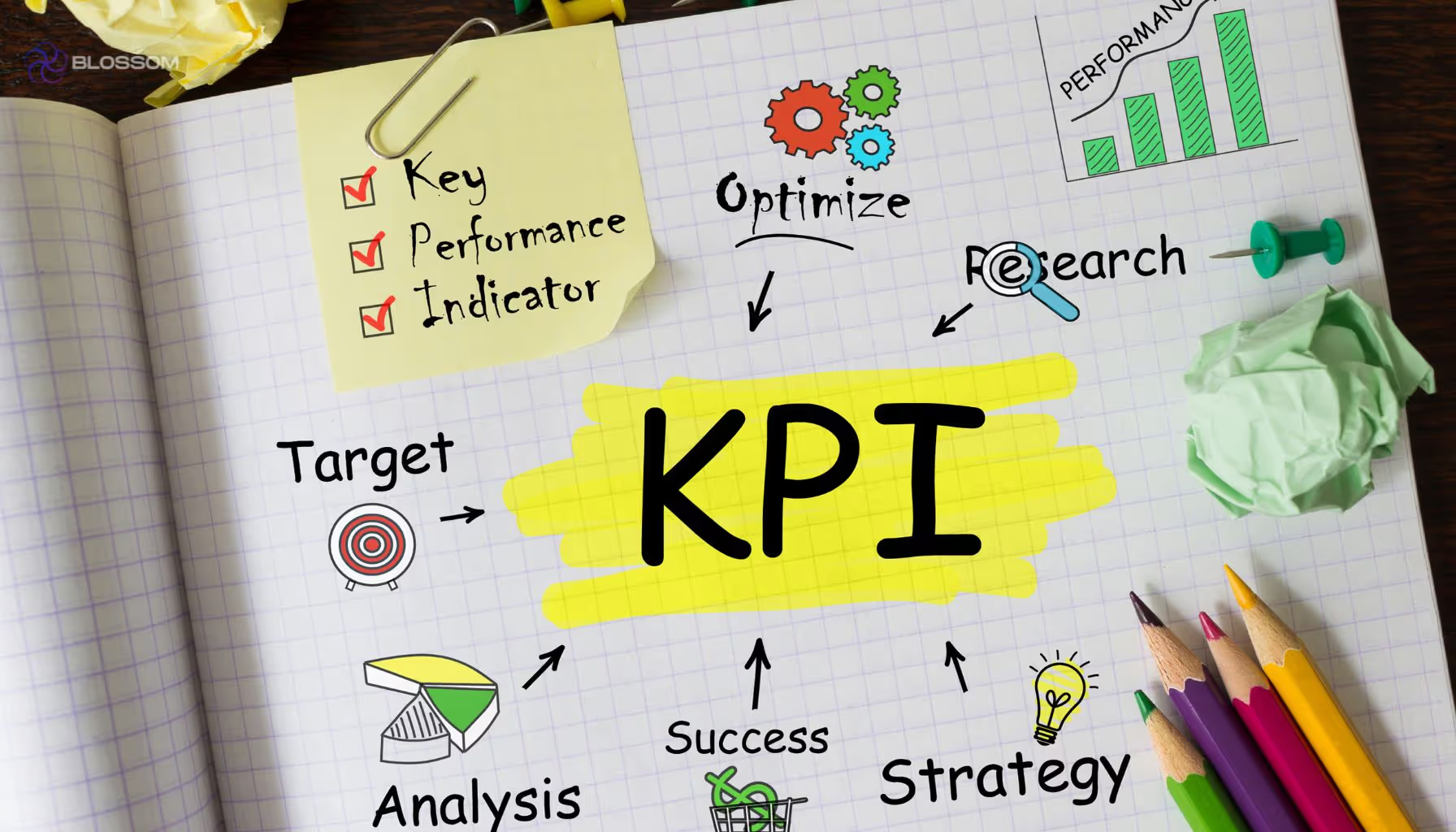
10 Email Marketing KPIs Every Marketer Needs to Know
3 Steps to Spring Clean Your Email Marketing Platform
How to Use Artificial Intelligence (AI) in Email Marketing in 2024

How To Create Marketing Emails That Engage Your Audience and Get Results
Why SMS is the Perfect Addition to Any Marketing Mix
Why Personalization is Critical for eCommerce Growth

How to Grow Your Startup’s Email List: Lessons from Daycation

How We Achieved a 27% Winback Rate with a Smart Email Strategy for Dumpling
The Hidden Pitfalls of Email Marketing: Blacklists and Spam Traps
The iOS18 Mail Update: What Marketers Need to Know
Supercharging Customer Journey Automations with Email Touchpoints
Why Your Abandoned Cart Series Needs More Than One Email
13 Simple Design Hacks Using Klaviyo Email Marketing & Shopify
5 Simple Tactics to Grow Your Klaviyo SMS List Without Overcomplicating Things

Why Klaviyo SMS Crushes Other SMS Providers (And How Ignoring It Costs You Revenue)

10 Klaviyo Strategies That Drove Over $50 Million for Our Clients
Email Marketing Management for eCommerce: A Real Guide
Email Marketing 101: How to Create Emails That Convert
Shopify Email Marketing: Campaigns + Automations That Actually Grow Sales
7 eCommerce Trends to Watch in 2025
The Complete Guide to Winning at B2B eCommerce in 2025
Answering YOUR Email Marketing Questions

What Is Email Marketing and Why Does It Work So Well?
5 Steps Toward a Successful Email Marketing Campaign

8 Proven Strategies to Build Your Email Marketing Lists in 2025

How to Supercharge Your Social Media with Email Marketing
The No-B.S. Guide to Ecommerce Email Marketing
How Email Can Power Your Customer Loyalty
How Much Does Email Marketing Cost in 2025?
Email Marketing 101: How to Create Emails That Convert

Create a Winning Welcome Email Strategy

How to Revitalize Your eCommerce Sales in the New Year
Customer Survey Emails: Finding the REAL Reason People Aren’t Buying

E-commerce Email Marketing: Dos, Don’ts, and Essential Tips for CBD Brands

The Ultimate Crash Course Email Marketing for E-commerce Store
3 Retention Metrics You’re Measuring Incorrectly + Strategies to Fix Them
How to Measure the Success of Your Email Marketing Strategy
How to Run A/B Tests in Email Marketing
9 Pillars of Email Marketing Success
Rethink Customer Loyalty: 7 game-changing strategies to retain customers
Good Email Marketer vs Bad Email Marketer
What is MMS and Why You Should Start Now
Why SMS is the Marketing Channel of the Future
EDM Marketing vs Email Marketing: What’s the Difference?
Case Study: How Smart Klaviyo Email Segmentation Boosted Conversions by 323%
6 Marketing Strategies to Future-Proof Your Marketing
Mastering Klaviyo Email Design: 11 Tips That Actually Work

How to Customize Shopify Email Templates Quickly and Efficiently

The Next Frontier of E-Commerce: What’s Coming and How to Prepare

Three Steps to Increasing Your Marketing Email Open Rates
Best Practices for Optimizing Email Flows with Klaviyo


Not Sure Where to Start?
Let's find the biggest retention opportunities in your business. Get a free Klaviyo audit or retention consultation.